Synthetic Photosynthetic Exoskeletons: Integrating Cyanobacterial Bio-Films with 3D-Printed Micro-Vascular Architectures for Carbon-Negative Urban Infrastructure Cooling
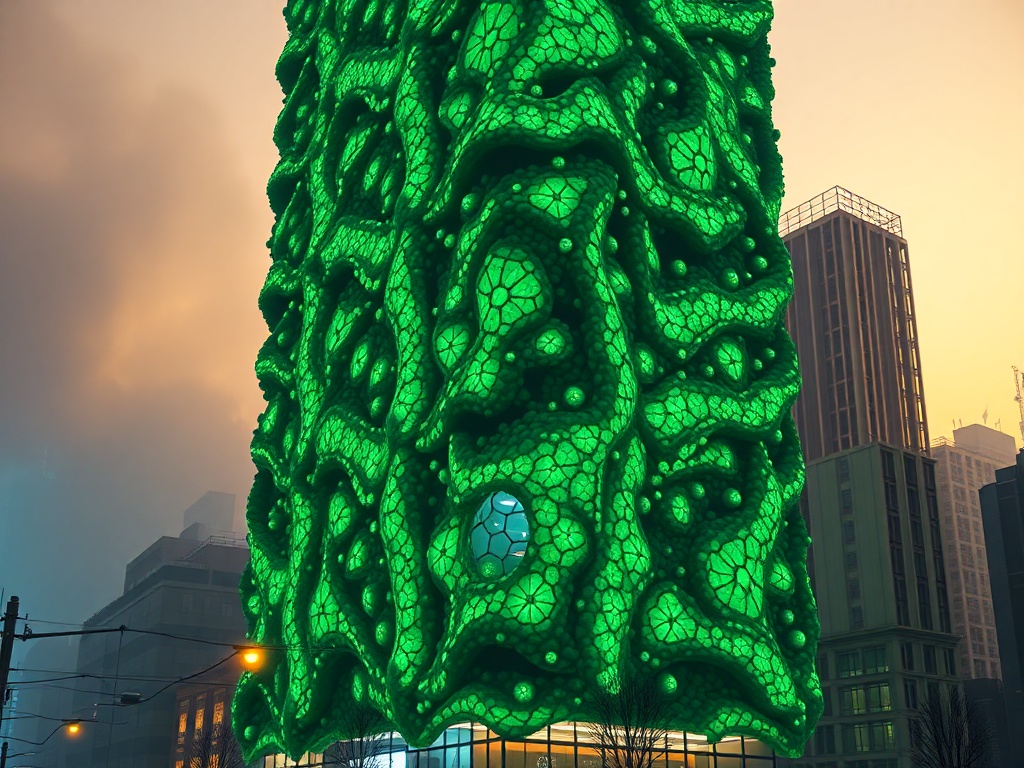
Urban environments are facing unprecedented challenges due to the compounding effects of global climate change and rapid urbanization. The concentration of concrete, asphalt, and steel in modern cities severely exacerbates the Urban Heat Island (UHI) effect, leading to dangerously elevated local temperatures. Concurrently, traditional building materials and operational energy demands remain massive contributors to global greenhouse gas emissions. To address these dual crises, researchers are pioneering radical new approaches to architectural design, shifting the paradigm from passive, inert structures to active, living facades.
At the forefront of this movement is the development of synthetic photosynthetic exoskeletons. This cutting-edge technology integrates living cyanobacterial bio-films with advanced 3D-printed micro-vascular architectures to create building skins that act as artificial, self-sustaining forests. By harnessing the ancient metabolic pathways of photosynthetic microorganisms, these bio-integrated facades offer a bio-mechanical solution to actively sequester carbon dioxide while simultaneously driving continuous evaporative cooling across the urban envelope.
3D-Printed Micro-Vascular Architectures
The structural foundation of a synthetic photosynthetic exoskeleton relies on sophisticated 3D-printable materials, typically advanced geopolymer concretes or bio-compatible hydrogel-elastomer composites. Traditional solid panels cannot sustain a uniform living biological layer because they lack the necessary mechanisms for nutrient and water distribution. To overcome this limitation, materials scientists employ additive manufacturing techniques to fabricate intricate, mathematically optimized internal geometries.
Inspired by the xylem and phloem networks found in vascular plants, these printed structures feature embedded branching capillary-like channels. This micro-vascular network is designed utilizing algorithms based on Murray's Law, or fractal branching principles, to ensure optimal fluid dynamics. The channels serve as an active circulatory system for the building facade, meticulously distributing water, essential minerals, and nutrients from a centralized reservoir outwards to the panel's surface.
The integration of this internal vascularization with a porous exterior substrate provides the optimal microenvironment for microbial colonization. The continuous, regulated perfusion of hydration strictly controls the moisture levels at the surface, preventing desiccation of the biological layer during periods of high solar irradiation while avoiding waterlogging, which could inhibit gas exchange. This structural ingenuity is the critical enabler for sustaining a robust, long-term living bio-film on vertical urban surfaces.

Cyanobacterial Bio-Films for Carbon Sequestration
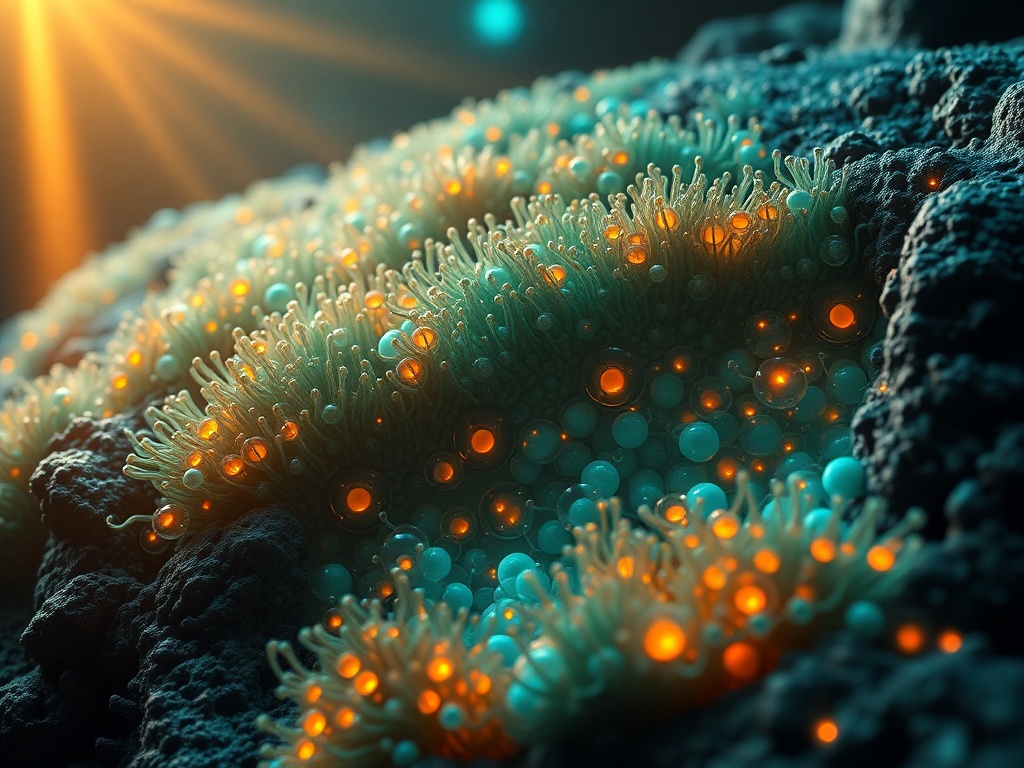
The operational core of the exoskeleton is the living biological layer: a densely packed bio-film composed of engineered cyanobacteria. Cyanobacteria are highly efficient, adaptable photosynthetic microorganisms capable of surviving in diverse and often harsh environments. When seeded onto the hydrated, porous exterior of the 3D-printed panels, these organisms secure themselves by secreting an extracellular polymeric substance (EPS), forming a resilient, adherent matrix.
Once established, the cyanobacterial bio-film functions as a vast, distributed bioreactor. Driven by the ample solar energy incident upon the building's facade, the microbes metabolize atmospheric carbon dioxide. Through the biochemical pathways of the Calvin Cycle occurring within their internal cellular structures, they fix inorganic CO2, converting it into complex organic biomass. This process actively strips greenhouse gases directly from the localized urban atmosphere.
Crucially, the efficiency of this biological carbon reduction is significantly greater per unit area than that of typical terrestrial plants. Furthermore, as a byproduct of this oxygenic photosynthesis, the cyanobacteria release pure oxygen into the surrounding air. Thus, the building exoskeleton not only acts as a continuous carbon sink but also serves to actively purify and re-oxygenate the immediate urban microclimate, effectively functioning as an artificial lung for the city.
Thermodynamic Mitigation of the Urban Heat Island
Beyond carbon sequestration, synthetic photosynthetic exoskeletons provide a powerful mechanism for thermodynamic regulation, directly combatting over-heated urban centers. Conventional building materials absorb vast amounts of solar radiation during the day, storing it as sensible heat, which is then re-radiated back into the city environment, creating the localized warming characteristic of an Urban Heat Island.
The bio-film facade intercepts a significant portion of this incoming solar radiation. A fraction of the light is utilized biologically for photosynthesis, but a far larger thermodynamic impact is achieved through the continuous physical process of evapotranspiration. As the micro-vascular network pumps water to the surface to sustain the cyanobacteria, a substantial amount of this moisture continually evaporates from the extensive surface area of the biofilm and the surrounding porous matrix.
The phase change of water from liquid to vapor requires a massive input of energy—specifically, the latent heat of vaporization. This continuous evaporation draws that required thermal energy directly away from the building envelope and the adjacent boundary layer of air. The result is a profound, active cooling effect that substantially lowers the surface temperature of the facade and, by extension, reduces the ambient temperature of the surrounding streets and pedestrian zones, demonstrating a highly effective, passive method for urban thermal management.
Conclusion
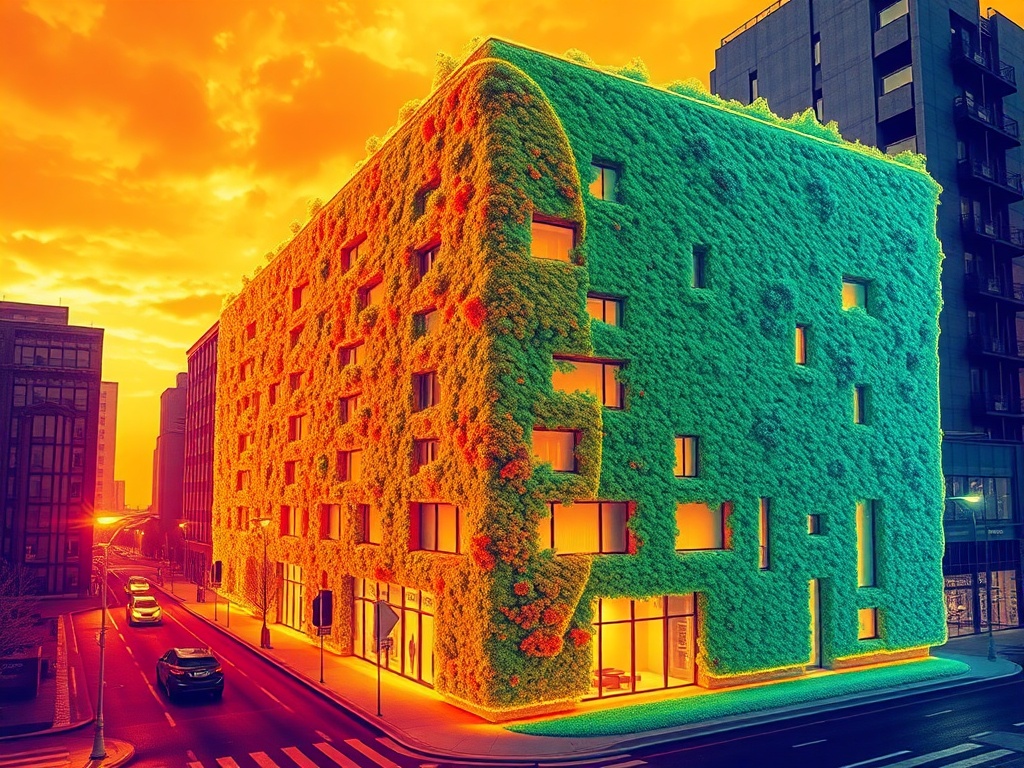
Synthetic photosynthetic exoskeletons represent a transformative convergence of biotechnology, advanced manufacturing, and architectural design. By intricately fusing 3D-printed micro-vascular lifesupport systems with resilient, biologically active cyanobacterial bio-films, we can redefine the role of the building facade. No longer merely passive shelter, these living skins become metabolically active participants in the urban ecosystem. Their dual capacity to autonomously draw down atmospheric carbon dioxide while simultaneously driving massive latent heat transfer for local cooling positions them as a cornerstone technology for the creation of truly sustainable, carbon-negative, and thermally resilient cities of the future.
References
- Cruz, C., et al. (2021). Bioreceptive materials for building facades: A review of potential and challenges. Building and Environment, 188, 107471. https://doi.org/10.1016/j.buildenv.2020.107471
- Wang, X., & Li, Y. (2022). 3D printing of microvascular networks for self-healing and bio-integrated materials. Advanced Functional Materials, 32(11), 2108502. https://doi.org/10.1002/adfm.202108502
- Perera, A. S., et al. (2020). Cyanobacteria-based living materials for environmental remediation and carbon sequestration. Nature Communications, 11(1), 5342. https://doi.org/10.1038/s41467-020-19131-y