Astro-Entomology: Designing Insect-Inspired Robots for Planetary Exploration
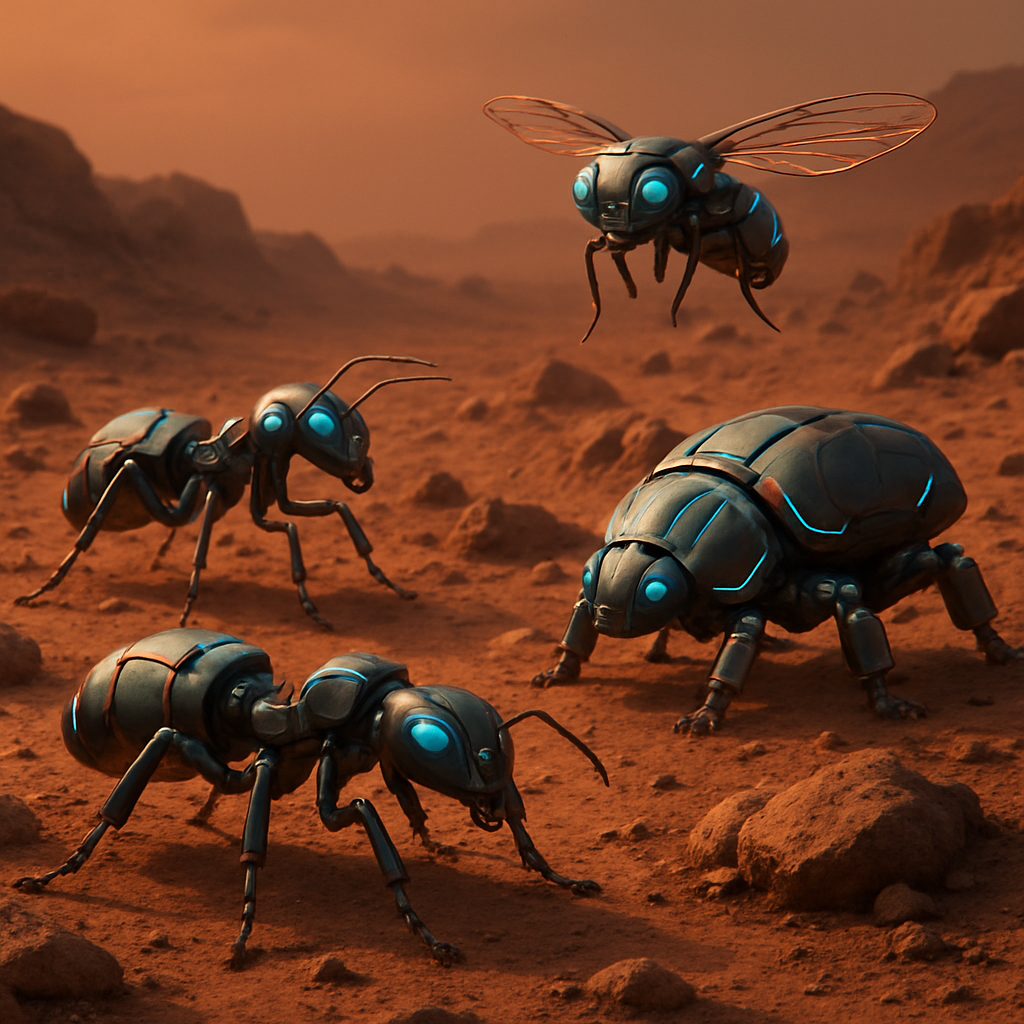
Insect-inspired robotics, or astro-entomology, is an emerging field that seeks to utilize the remarkable adaptations of insects in the development of exploration technologies for other planets. By mimicking the efficiency, resilience, and sensory capabilities of terrestrial arthropods, researchers aim to design robots capable of traversing and examining extraterrestrial environments that are otherwise inhospitable for humans and traditional machines. Drawing inspiration from nature offers unique solutions to the engineering challenges presented by alien terrains—such as unpredictable obstacles, extreme climates, and complex surfaces. The lessons learned from the biomechanics and eco-physiology of insects are foundational to developing robotic explorers that exhibit agility, autonomy, and environmental awareness.
Biomimetic Adaptations for Mobility and Durability
One of the most significant benefits of insect-inspired design choices is the variety of locomotion strategies observed in nature. For example, ant-like robots implement multi-legged gaits that allow them to maneuver across uneven and rocky surfaces with stability. Beetle-inspired forms can carry substantial payloads relative to their size thanks to their rigid exoskeletons and powerful limbs. Fly-inspired aerial and jumping mechanisms open avenues for vertical exploration and navigation of obstacles. These biomimetic adaptations extend to surface traction, where microspine and adhesive pads—borrowing from beetles and flies—enable robot adhesion to challenging surfaces. Durability is ensured by flexible joint designs and segmented exoskeletons that absorb impact and resist dust ingress, a crucial feature on planets like Mars where fine particulate matter poses a significant operational threat.

Sensory Systems and Autonomy
Insects are renowned for their highly specialized sensory organs, such as antennae, compound eyes, and mechano-receptors, which enable them to navigate complex environments. Roboticists incorporate optical cameras, chemical sensors, and tactile arrays derived from these biological models to endow planetary robots with autonomous navigation and environmental interaction. Sensor fusion—using inputs from multiple sensor types—improves robustness by allowing robots to interpret terrain texture, atmospheric composition, and the presence of obstacles even in low-light or dust-obscured conditions. Distributed sensor networks, inspired by insect swarms, facilitate coordinated exploration and data collection, allowing groups of robots to function as a cohesive unit.

Applications in Planetary Science
Insect-inspired robots offer unprecedented opportunities for scientific discovery on other worlds. Their agility and adaptability make them ideal for exploring lava tubes, caves, cliffs, and craters where traditional wheeled or tracked vehicles may struggle. Swarm robotics, reflecting the social behaviors of ants and bees, enable large-scale mapping and sampling over wide and inaccessible areas, increasing mission redundancy and data reliability. By employing modular body designs, these robots can be rapidly reconfigured or repaired in the field, enhancing mission longevity. Autonomous decision-making capabilities, paired with advanced sensor systems, enable robots to independently prioritize targets of interest such as geological formations or potential biosignatures.

Conclusion
Astro-entomology signifies an exciting frontier for space sciences and robotics engineering. By closely studying and emulating the adaptive strategies of Earth's insects, engineers are developing versatile, robust, and intelligent exploration robots that promise to expand the reach of humanity's search for knowledge across the solar system. The fusion of biological insight and technological innovation is reshaping our concept of what is possible in the continuing quest to explore extraterrestrial landscapes.
References
- Bar-Cohen, Y. (2006). Biomimetics—using nature to inspire human innovation. Bioinspiration & Biomimetics, 1(1), P1–P12. https://doi.org/10.1088/1748-3182/1/1/P01
- Kovac, M. (2013). The bioinspiration design paradigm: A perspective for soft robotics. Soft Robotics, 1(1), 28–37. https://doi.org/10.1089/soro.2013.0002
- Wood, R.J. (2008). The First Takeoff of a Biologically Inspired At-Scale Robotic Insect. IEEE Transactions on Robotics, 24(2), 341–347. https://doi.org/10.1109/TRO.2008.916997
- Saranli, U., Buehler, M., & Koditschek, D.E. (2001). RHex: A Simple and Highly Mobile Hexapod Robot. The International Journal of Robotics Research, 20(7), 616–631. https://doi.org/10.1177/02783640122067570